
Current Exhibition
What is Wrong with Robert Hamilton?
Encaustics, sculpture, digital prints and a 1998 reliquary by Robert Hamilton.
Opening night: Friday, November 13, 7 to 11 PM
The Bookstore Gallery, 461 Nelson St SW, Atlanta, GA 30313
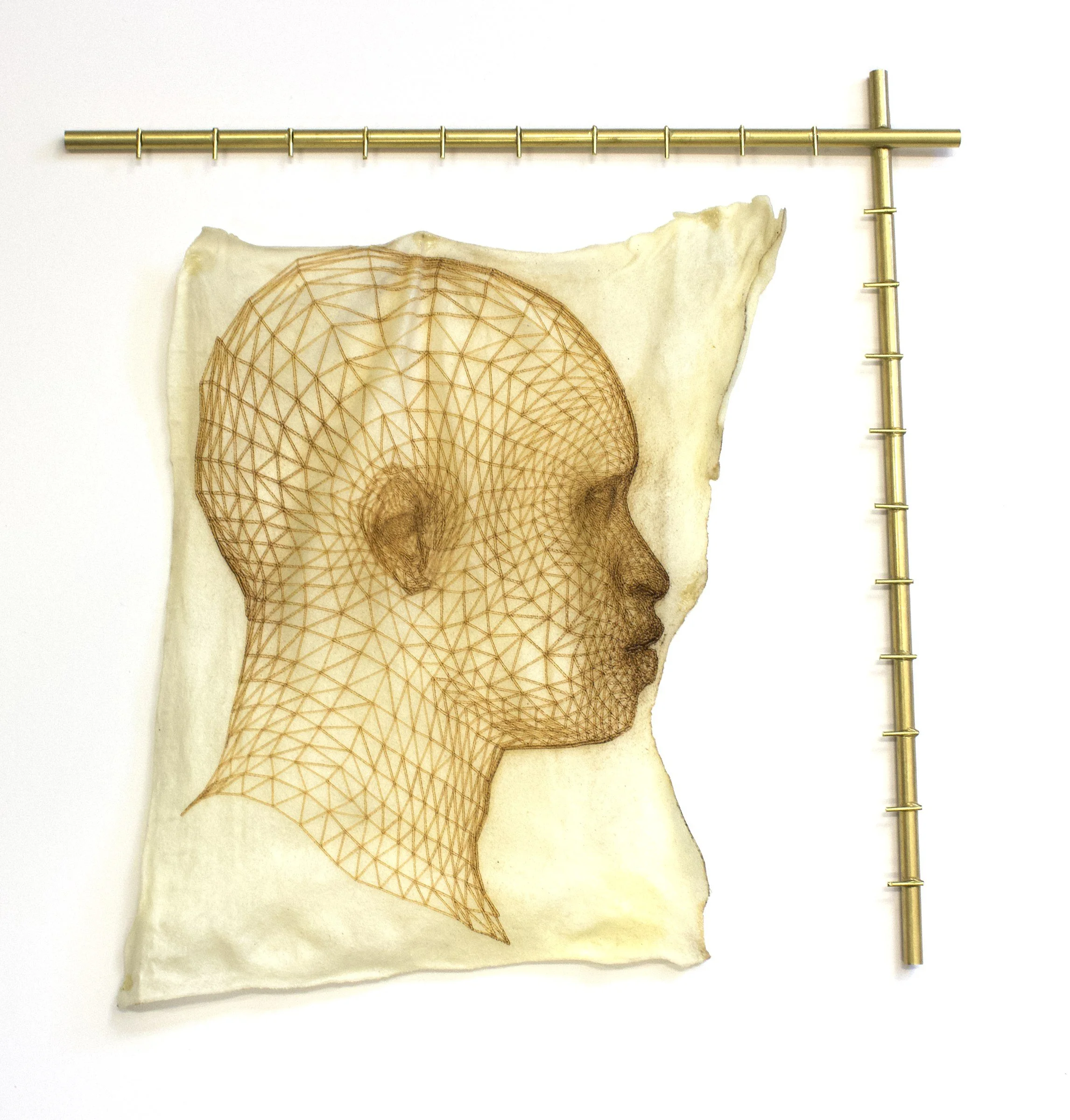
Image: Robert Hamilton, Analysis of the Ideal series (1), 2018, rawhide and brass, 15 × 18
“Mechanical and organic together into something that is new and different.”
Robert Hamilton
Robert Hamilton
About the Exhibition
Fleshy and mechanical, familiar yet wholly unknown, the work of Robert Hamilton resists easy classification. What is Wrong with Robert Hamilton? brings together encaustics, sculpture, digital prints and a reliquary from 1998 to survey an artist whose practice has evolved continuously across media and decades. Hamilton moves between ancient painting methods and fractal algorithms, raw hide and rendered light, building a world where architecture decays, organisms emerge from mathematics and the line between body and machine dissolves.
Much of Hamilton's recent work begins in Mandelbulber, a program that generates three-dimensional fractals. Rather than run a single equation, Hamilton layers several fractal formulas so that each one shapes the next. He then refines the resulting forms through careful adjustments to lighting, shadow and color base. The images that emerge recall coral, cellular tissue and alien terrain, yet at their core they remain products of pure mathematics. His constructed abandoned buildings, encaustics and works in raw hide take up degradation as both subject and process: the slow transformation of structures, landscapes and bodies over time.
Across the exhibition, Hamilton deliberately sets the human figure aside, freeing the work from the questions of identity that representation so often carries. What remains is at once recognizable and strange. His forms suggest a dancer, a creature, a mountain or a cell without settling on any one of them. The title poses its question with a wink. Rather than diagnose the artist, it invites viewers to sit with the unease and wonder of forms that are fleshy, glitched and still becoming, and to consider what these unsettled shapes reveal about living, dying and everything in between.
The exhibition also celebrates Hamilton's 35-year career in higher education at Spelman College, where he has shaped generations of artists.
“Mechanical and organic together into something that is new and different.” — Robert Hamilton
Selected Works
Digital Flesh series
The works in the Digital Flesh series sit between sculpture and digital image, and each holds two states at once. One side of each form reads as architectural, even textile-like, its ordered surfaces recalling weaving or masonry. The other gives way to something unmistakably meaty and organic. Hamilton conceived these objects as sculptures suspended in space, and the series points toward a planned body of physical work joining circuit boards with dead wood and moss. The forms invite comparisons to cyborgs or androids, but Hamilton resists those labels. He is after a fusion of the mechanical and the organic that feels genuinely new.
Cellular Aberrance
Cellular Aberrance belongs to a series of fractal orbs, each defined by repeating patterns that wrap around an organic core. It is the one that did not render as intended. A glitch in the underlying algorithms scattered its surface with marks absent from its perfectly spherical counterparts. Rather than discard the error, Hamilton embraced it and named the work for its departure from the norm. The piece reflects an openness that runs throughout his practice, where chance and failure become generative forces.
Fractal prints
In a group of recent prints, Hamilton begins to approach personality and the face without depicting the human form. In one work he placed a single sphere within the folds of the composition to act as an eye, so that the form seems to return the viewer's gaze. Read in sequence, the prints move from flesh and blood toward structure and skin, as if offering successive views of one organism at different scales, from the molecular to the visible surface.
Reliquary, 1998
The earliest work in the exhibition recalls the vessels that have long held sacred remains. From a distance its forms resemble skeletal beings, drawing a direct line between Hamilton's earlier work and the bone-like, bodily structures of his recent digital practice.
This work is inspired by the tight-knit Commodore Amiga community that is still active today. Thinking broadly, the similarities and differences that we deal with once sacred written text and throw-away media have now become apparent in the use of the external disk drive and floppy disks. Even now, floppy disks - which was still popular when the piece was created - are considered to be ancient as antiquated as the books themselves.
Encaustics, raw hide and constructed ruins
Hamilton's engagement with ancient methods is clearest in his encaustics, a technique of painting with heated wax that dates to antiquity. Shown alongside his constructed abandoned buildings and works in raw hide, these pieces trace the natural degradation of architecture and the natural world, and they position decay as a continuous and creative process.
Works in the Exhibition
Digital prints
All digital prints are editions of five.
Untitled, 2023–2024, 85 × 65 (four works)
Degeneration, 2025, 60 × 14
Dark Entrance, 2024, 21 × 18
Digital Flesh series (1), 2023, 21 × 18
Untitled, 2019, 21 × 18
Untitled, 2025, 21 × 18 (three works)
Orifice series 1a, 1b and 1c, 2025, 21 × 18
Landscape series 1a, 1b and 1c, 2025, 12 × 9
Mixed media
Amiga Reliquary, 1998, 14 × 10
Rawhide and brass
Untitled, 2018 (two works)
Analysis of the Ideal series (1), 2018, 15 × 18
Analysis of the Ideal series (2, self), 2018, 15 × 18
Encaustic
Amalgamation, 2024, 8 × 12
Quantify the Being series 1a, 2024, 8 × 12
Fetid Dialog, 2024, 18 × 26
Laser-cut wood
Pixel Pot, 2018, 12 × 23
Fractal, 2018, 13 × 5
Ceramic
Untitled (vase), 2026, 6 × 12
Untitled (honey dipper), 2026, 4 × 5